
In today’s rapidly evolving world, success depends not only on knowledge but on the ability to analyze, interpret, and apply information effectively. Analytical thinking enables students to approach challenges logically, evaluate evidence critically, and make informed decisions. At Billabong High International School, Noida (BHIS Noida), the Cambridge curriculum is designed to cultivate these essential skills from an early age.
A Skill-Based Global Framework
The Cambridge curriculum, developed by Cambridge Assessment International Education, is internationally recognized for its focus on developing independent learners. Rather than relying on rote memorization, it encourages students to understand concepts deeply and apply them in diverse contexts.
This approach nurtures learners who are confident, reflective, responsible, innovative, and engaged—qualities that form the foundation of analytical thinking.
Inquiry-Led Learning
A hallmark of the Cambridge framework is inquiry-based education. Students are encouraged to ask meaningful questions, explore multiple solutions, and justify their answers with reasoning.
In classrooms at BHIS Noida:
- Discussions replace one-way lectures.
- Projects encourage research and investigation.
- Real-world case studies stimulate practical thinking.
By consistently engaging in inquiry, students learn to examine problems from different angles and develop logical reasoning skills.
Conceptual Clarity Over Memorization
Analytical thinking begins with strong conceptual understanding. The Cambridge curriculum ensures that students grasp the “why” behind every concept.
For example:
- Mathematics emphasizes problem-solving strategies rather than repetitive practice.
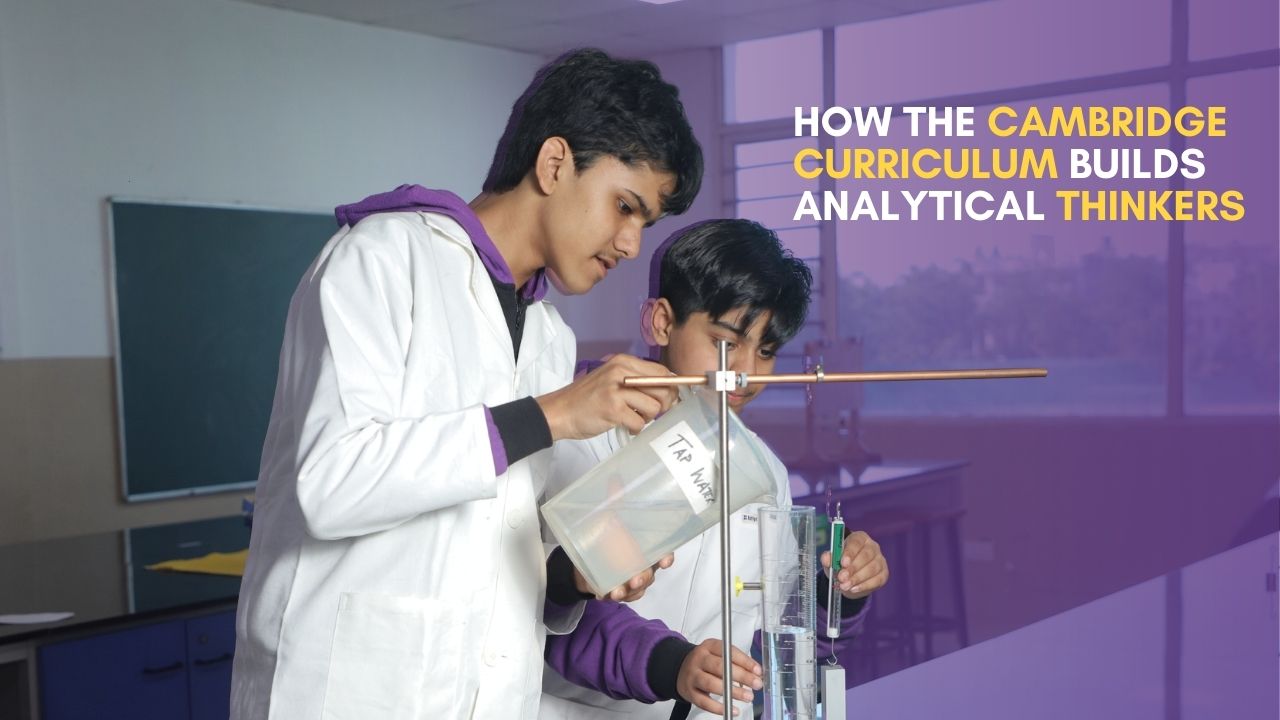
- Science focuses on experimentation and observation to understand cause and effect.
- Humanities subjects involve evaluating perspectives and interpreting evidence.
This depth of understanding empowers students to apply knowledge confidently in unfamiliar situations.
Structured and Thought-Provoking Assessments
Cambridge assessments are designed to test application, interpretation, and evaluation. Students are often required to explain reasoning, compare viewpoints, and analyze data.
At the secondary level, programs such as the International General Certificate of Secondary Education (IGCSE) challenge students with structured analytical questions that prepare them for advanced academic pathways.
This assessment style reinforces logical thinking and strengthens written argumentation skills.
Research and Independent Learning
The Cambridge pathway encourages students to conduct independent research and present findings confidently. At BHIS Noida, students regularly work on projects that require them to:
- Gather and evaluate information
- Identify credible sources
- Interpret data
- Present evidence-based conclusions
These research skills build intellectual curiosity and analytical depth—qualities essential for higher education.
Exposure to Global Perspectives
With its international framework, the Cambridge curriculum introduces students to global case studies and diverse viewpoints. Exposure to different cultural, economic, and social contexts broadens understanding and enhances critical evaluation skills.
Students learn to compare perspectives, respect differing opinions, and construct balanced arguments—key aspects of analytical development.
Preparing Future-Ready Thinkers
In competitive academic and professional environments, analytical thinkers stand out. They approach challenges with clarity, confidence, and creativity. Through its learner-centered and inquiry-driven approach, BHIS Noida ensures students are equipped with the mindset required to succeed globally.
Conclusion
The Cambridge curriculum does more than deliver academic content—it shapes how students think. By emphasizing inquiry, conceptual clarity, research, and structured evaluation, it builds strong analytical thinkers prepared for future challenges.
At Billabong High International School, Noida, this progressive approach empowers students to move beyond memorization and become confident problem-solvers ready for higher education and global opportunities.