

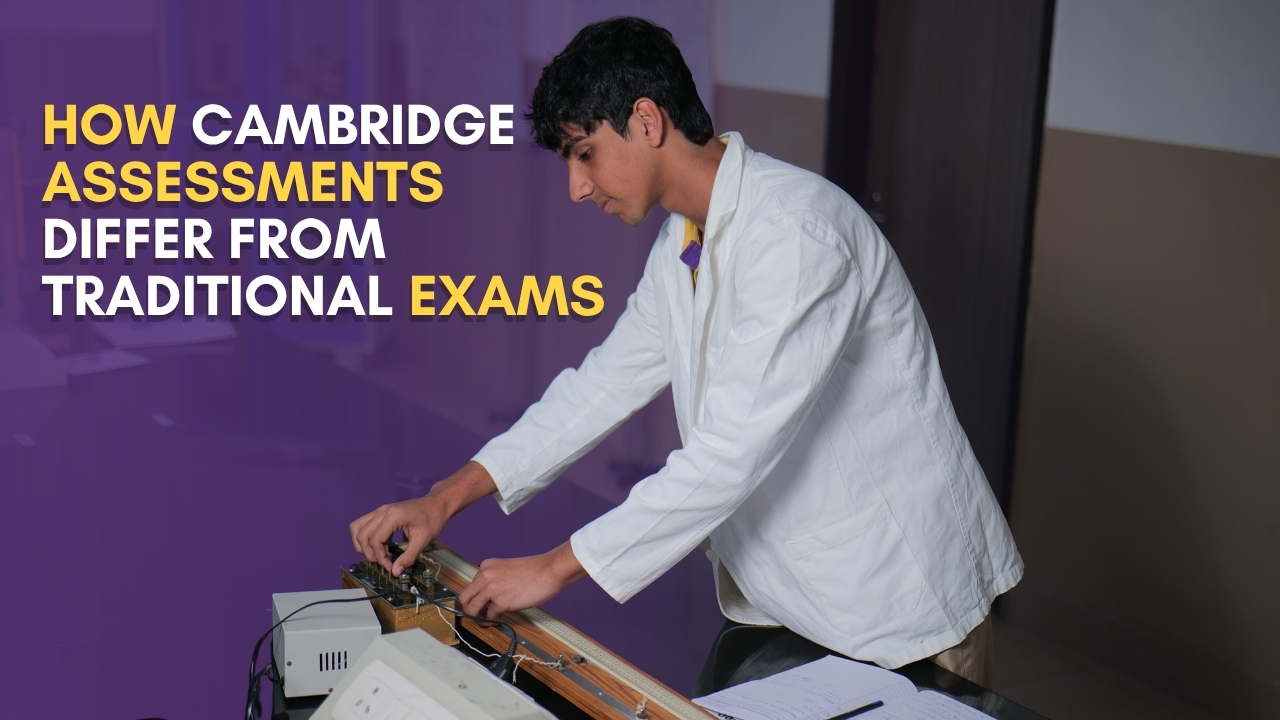
 Assessment plays a crucial role in shaping how students learn. While traditional examination systems often focus on memorization and end-term performance, the Cambridge assessment framework emphasizes understanding, application, and skill development.
At Billabong High International School, Noida (BHIS Noida), the Cambridge pathway is designed to evaluate students in a way that reflects real learning, not just exam preparation.
Understanding the Cambridge Assessment Approach
The Cambridge curriculum, developed by Cambridge Assessment International Education, follows an internationally benchmarked system that prioritizes conceptual clarity and analytical thinking.
Unlike traditional exams that often test recall-based knowledge, Cambridge assessments are structured to measure how well students:
- Apply concepts in new situations
- Analyze information critically
- Interpret data and case studies
- Construct logical and structured answers
This ensures students truly understand what they are learning.
Focus on Application Over Memorization
In many traditional exam systems, students prepare by memorizing textbook content and reproducing it during exams. While memory plays a role, it does not fully measure understanding.
Cambridge assessments differ by:
- Asking scenario-based questions
- Including real-world problem-solving tasks
- Requiring explanation of reasoning
- Encouraging evaluation of multiple perspectives
Students at BHIS Noida are trained to think beyond textbooks, which strengthens long-term retention and practical knowledge.
Continuous and Structured Evaluation
Traditional systems often rely heavily on final exams to determine academic performance. Cambridge, however, incorporates a balanced approach to assessment that may include:
- Internal assessments
- Practical work and experiments
- Research-based assignments
- Written examinations
This multi-dimensional evaluation provides a more comprehensive picture of a student’s abilities.
At the secondary stage, programs such as the International General Certificate of Secondary Education (IGCSE) combine theoretical understanding with practical and analytical components, preparing students for global academic standards.
Emphasis on Critical Thinking and Analysis
Cambridge exams are designed to test higher-order thinking skills. Students are expected to:
- Interpret graphs and data
- Compare and contrast viewpoints
- Justify answers with evidence
- Develop structured arguments
This approach develops analytical and reasoning skills that are essential for higher education and competitive careers.
Global Benchmarking and Recognition
One key difference between Cambridge assessments and many traditional systems is international recognition. Cambridge qualifications are accepted by universities worldwide, ensuring global academic mobility.
Students at BHIS Noida benefit from an assessment framework that meets international standards, giving them a competitive edge when applying to universities in India and abroad.
Reducing Exam Stress Through Preparedness
Because Cambridge focuses on understanding and skill-building throughout the year, students are better prepared and less reliant on last-minute memorization. Regular practice of analytical and application-based questions builds confidence and reduces exam anxiety.
Preparing Students for the Real World
Traditional exams may test knowledge at a specific point in time, but Cambridge assessments are designed to prepare students for real-world challenges. By emphasizing problem-solving, communication, and evaluation skills, the system ensures students are ready for university-level academics and professional environments.
Conclusion
Cambridge assessments differ from traditional exams by prioritizing understanding over memorization, application over repetition, and skill development over short-term performance.
At Billabong High International School, Noida, this progressive assessment approach empowers students to become confident learners, critical thinkers, and globally competitive individuals.